

Trusted, real-time customer context: The foundation for faster decisions
Thu, 20th Aug 2026
Organisations seeking to make faster, more relevant customer decisions should start with focused use cases and build trusted, event-driven data foundations that can support real-time action across the enterprise, according to leaders from AWS and Amperity.
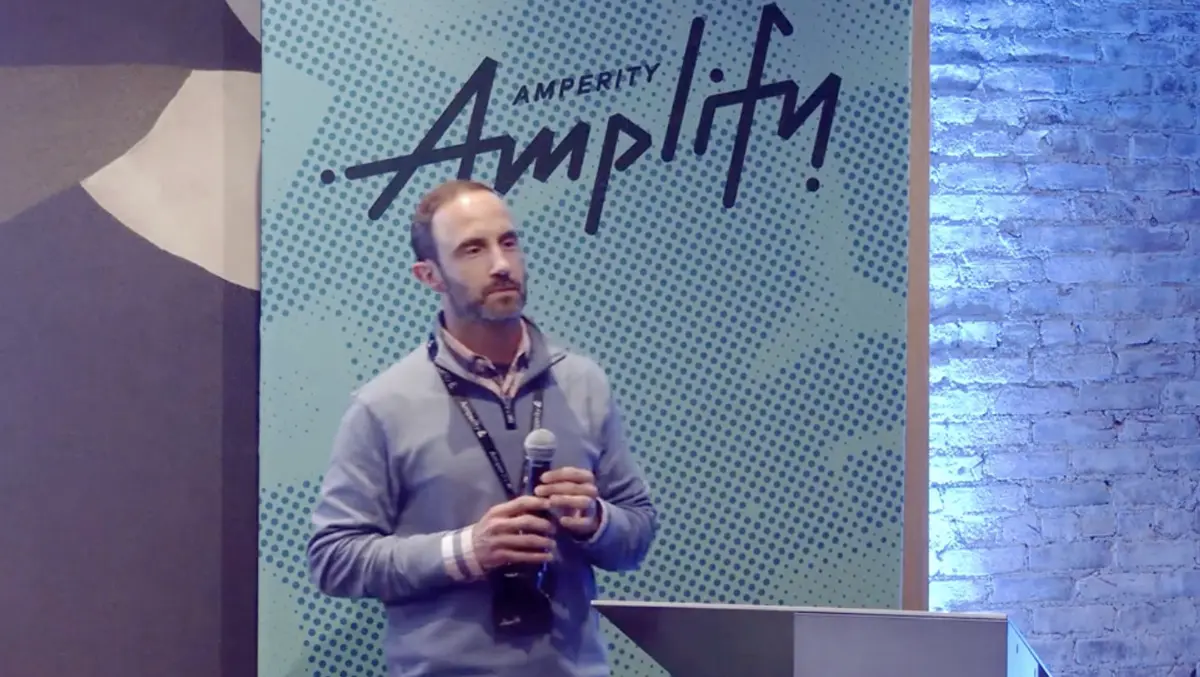
Speaking during the Architecting for Trusted, Real-Time Decisions session at Amperity's Amplify 2026 conference, Steven M. Elinson, Director, AWS for Travel & Hospitality, and Thomas Koep, Vice President of Customer Strategy at Amperity, outlined how organisations can combine historical customer profiles with live behavioural signals.
Their central message was that real-time personalisation and revenue recovery are valuable starting points, but the larger opportunity is a governed customer context that marketing, operations, customer care and AI agents can all trust.
Why real-time customer context matters now
Travel and hospitality provide a particularly clear view of why real-time customer intelligence is becoming more important.
Elinson said the industry's historical "look-to-book" ratio had grown from about 10,000 to one to 100,000 to one as metasearch and online travel agencies expanded choice.
In an agentic future, that ratio is predicted to reach one million to one as AI agents search and assemble combinations on consumers' behalf. At the same time, a customer may have different personas depending on the occasion. Knowing who the person is therefore needs to be combined with an understanding of why they are engaging at that moment.
"It's not just enough to know who the person is, you have to know the occasion and why they're coming to visit you," Elinson said.
The need is intensified by the perishable nature of travel inventory. An unsold hotel room, airline seat or cruise cabin cannot be held for later, and the lost booking can also remove opportunities for ancillary revenue.
Real-time personalisation and abandoned-cart recovery may provide an immediate commercial case, but Elinson said the more strategic opportunity is eliminating fragmented customer views.
Marketing, operations and customer care often hold different versions of the same traveller or guest. That fragmentation creates inconsistent experiences today and greater risk as AI agents begin making and executing decisions at scale.
"The future requires that we eliminate that and have a single version of truth. Although the revenue recovery pieces we're talking about today are important, it's this second piece, the unified truth, that's going to be most important in the agentic future that's coming," Elinson said.
AI agents will require access to accurate profile information, the customer's current journey, sentiment and relevant historical context. A shared, governed customer record allows human teams and AI agents to make informed decisions from the same foundation.
Build a trusted, event-driven data foundation
Many organisations still depend on batch processes and daily refreshes to resolve customer identity, build segments and activate data. That delay creates a window in which a customer's context can change, or the customer can choose another brand, before the organisation responds.
Koep said real-time and batch data no longer need to operate as separate systems. Unknown signals, such as anonymous browsing behaviour, can be collected over time and connected to an existing customer profile as soon as the person logs in or provides identifying information.
"The interesting thing going forward: you can now use all those unknown signals, bring them into your tenant, store them over time, and the second a guest logs in or provides a piece of PII, you unify all that historical browsing behavior to an Amperity ID," Koep said.
Once connected, in-session behaviour can be used alongside transaction history, preferences and other profile attributes without waiting for an upstream micro-batch or daily refresh. This supports journeys and decisions based on a customer's current context while retaining the historical knowledge needed to avoid overreacting to a single click or view.
Elinson said event-driven architecture is the mechanism that enables organisations to detect signals, ingest them rapidly and use the resulting insights to shape customer experiences.
For travel and hospitality businesses, this capability must serve two durable needs at the same time: improving the guest experience and strengthening operating margins.
"So how do you do both? How do you elevate the guest experience while also improving operating margins? It's through things like event-driven architectures that give you the data and insights to inform both," Elinson said.
Signals may include structured and unstructured data, clickstream activity, information supplied directly by customers, behavioural observations from transaction systems, partner data and third-party sources.
Streaming services can ingest those signals at high volume and low latency. The data then needs to be standardised, catalogued and made available through storage and database services suited to the specific outcome.
Elinson cautioned against assuming that every problem can be solved with one type of database. Real-time personalisation, economical long-term storage, enterprise analytics and relationship-based insights can require different fit-for-purpose services.
Elinson said an emerging priority is making data catalogues open and available across the enterprise rather than locking them inside a single vendor environment. Open table formats can help organisations retain flexibility, experiment with emerging technologies and connect customer information to new tools without slowing innovation. This becomes increasingly important as AI capabilities and vendors evolve. Organisations need the freedom to test new approaches while maintaining governed access to trusted customer data.
Koep similarly described an open, API-based architecture in which real-time customer information can serve different applications. Unifying event streaming and batch processes can also reduce reliance on multiple point solutions. "Audit your tech stack and ask: do I still need event processor X and event processor Z? Because you can take that money and reinvest it back into the platforms that hold all your customer information in the first place," Koep said.
Start with a vertical slice and prove value
The organisations moving fastest are not waiting to ingest every possible signal before they begin. Elinson recommended taking a "vertical slice": identifying the data needed for one business hypothesis, building the supporting pipeline, validating the outcome and then repeating the process.
"We've seen some brands spend two years trying to get every single possible signal into their ecosystem before they can go and do personalisation or revenue recovery and that doesn't bring value to the business," Elinson said.
The approach gives organisations a way to move from architecture diagrams to measurable outcomes without completing a multi-year infrastructure transformation first. It also creates an iterative pattern for expansion. Each proven use case helps clarify which additional signals, services and capabilities will deliver the next increment of value.
Elinson pointed to examples demonstrating the commercial and operational impact of event-driven architectures. South Korean hyper-retailer Lotte Mart increased its personalisation conversion rate by more than five times after moving to an event-driven architecture. The improvement came from better understanding who the customer was, where they were in their journey and how to activate that context.
Elinson also noted that systems must be elastic enough to respond to sudden demand. Limited-time offers and major events can create significant transaction spikes, requiring architecture that can scale up quickly and then reduce capacity to avoid unnecessary operating cost.
Expedia's digital model provides another example. Elinson said the travel seller has complete coverage across its data pipeline, enabling channel, revenue, distribution, marketing and other teams to access the insights needed to drive outcomes. "We know the architecture works. It works at scale, and it works for some of the most loved and well-known brands in the world," Elinson said.
Extend real-time decisions across the enterprise
Koep said digital personalisation is one of the easiest applications to understand, but real-time customer context can also support loyalty and operations.
For example, a hospitality business could combine geolocation or check-in signals with an existing guest profile to trigger a personalised welcome. If the guest qualifies for a higher loyalty tier at check-in, that status could be updated immediately and reflected across downstream systems before the guest reaches their room.
"The signals are just events and traits, you can send that information at the speed your customers actually expect, hyper-personalising those downstream systems as fast as possible," Koep said.
Closed-loop data also allows email opens, clicks and web behaviour to flow back into the customer profile immediately, supporting faster optimisation without waiting for other systems to process and return the information.
Prepare customer intelligence for AI
Real-time inputs can provide AI systems with current context that was previously delayed by four-hour batches or daily refreshes. This creates opportunities to train, update and apply models using recent customer activity while maintaining connection to a trusted enterprise profile.
Koep summarised three capabilities organisations should prepare for: connecting unknown activity to a known customer profile, using that context in real-time journeys at scale, and extending the architecture beyond digital experiences into loyalty, operations and other enterprise programs.
Elinson said the goal is to give the entire organisation access to a governed source of high-quality, secure customer information. "You want to give your entire organisation access to that governed, single source of truth: high-quality, secure information that lets you continue to accelerate outcomes and make sure you're ready for what's coming," Elinson said.
The emerging architecture is not simply about making marketing faster. It is about giving every authorised system and team the trusted context needed to make better decisions in the moments that matter.
About the Amplify 2026 discussion
The insights in this thought-leadership material are drawn from the publicly available Architecting for Trusted, Real-Time Decisions session at Amperity's Amplify 2026 conference.
This piece focuses on comments from:
- Steven M. Elinson, Director, AWS for Travel & Hospitality, AWS; and
- Thomas Koep, Vice President of Customer Strategy, Amperity.
Session page and transcript here.