

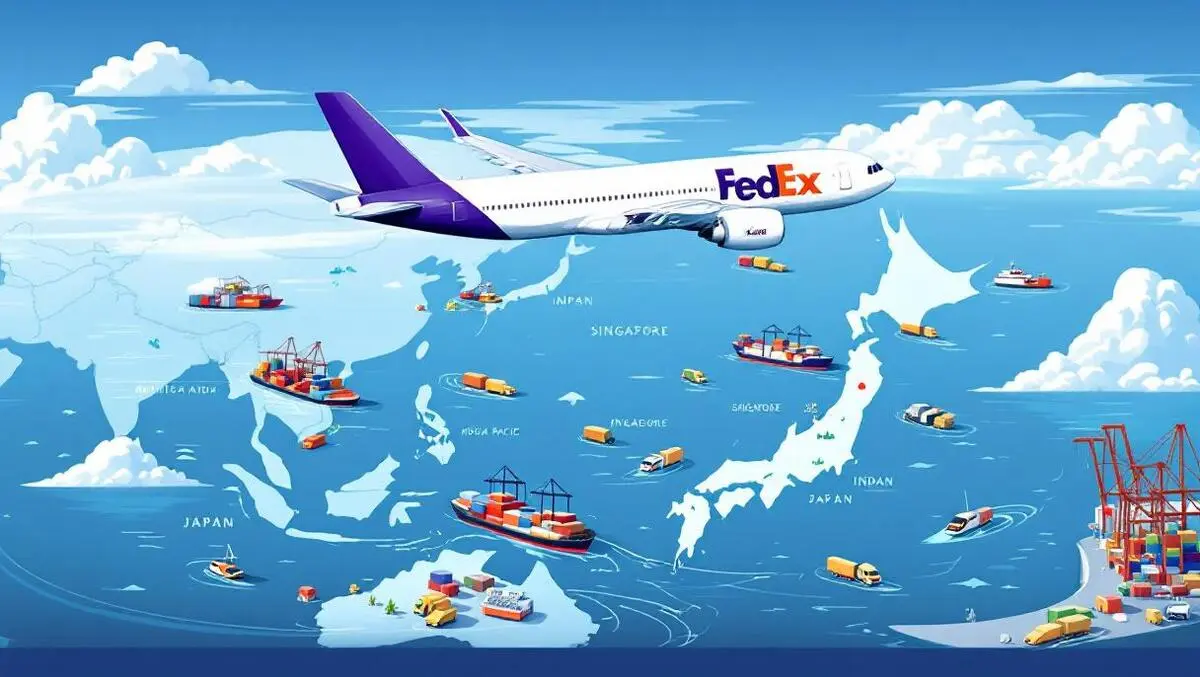
FedEx impact in Asia Pacific hits USD $5.7 billion
Wed, 7th Jan 2026
FedEx has reported that its operations generated an estimated USD $5.7 billion in economic impact across Asia Pacific in its 2025 financial year, as the logistics group expands routes, facilities and digital services in a region it describes as central to global trade.
The figure forms part of a wider assessment of the company's global footprint, which calculated USD $126 billion in direct and indirect impact worldwide in the year. The study, produced with data and analysis from Dun & Bradstreet, benchmarks FedEx against other large employers and examines its effects on sectors including manufacturing and transport.
FedEx has operated in Asia Pacific for more than four decades and now employs tens of thousands of staff across 43 countries and territories. The region includes major export economies such as China, Japan, South Korea and India, as well as fast-growing markets in Southeast Asia.
The company said its direct activities represented 0.1% of net economic impact in Asia Pacific's transportation, storage and communications sector. It estimated a further USD $1.6 billion in indirect contributions to the region's wider economy, including USD $510 million in the transportation, storage and communications sector and USD $484 million in manufacturing.
Combined direct and indirect contributions in Asia Pacific totalled about USD $5.7 billion for the year, according to the report.
Salil Chari, Senior Vice President, Marketing and Customer Experience, FedEx Asia Pacific, said the region sits at the heart of shifting global trade flows.
"Asia Pacific is one of the most dynamic and diverse markets in the world," said Salil Chari, senior vice president, marketing and customer experience, FedEx Asia Pacific. "It holds 60%[4] of the world's population and is an increasingly important driver of the global economy. That means the FedEx Effect has a particularly significant impact here and will continue to do so into the future. Our customers span small eCommerce entrepreneurs to global manufacturers. We continue to invest in the region to enhance our network and operations and introduce new digital innovations to make supply chains smarter, faster, and more sustainable so our customers can compete and thrive in an evolving global economy."
FedEx operates what it describes as the world's largest express transportation company. Its global network reaches more than 220 countries and territories, supported by over 500,000 employees and 5,000 facilities. The company handles about 17 million packages a day and moves goods valued at more than USD $2 trillion each year.
New flight links
In Asia Pacific, the group has expanded air routes and local infrastructure as trade patterns evolve and as businesses adjust supply chains within and beyond the region.
Recent operational changes include a new direct round-trip flight between Singapore and the United States. FedEx has also introduced a route that links its Asia Pacific hub in Guangzhou with Bangalore, the United Arab Emirates, Liège and Paris. The company has increased the frequency of two China-US routes, between Qingdao and Memphis via Osaka, and between Xiamen, Anchorage and Memphis via Incheon.
On the ground, FedEx opened a gateway facility in Denpasar, Bali. The site provides export connections via Singapore. In Thailand, the company launched a parcel and freight facility in Laem Chabang, in the Eastern Economic Corridor, which has become a focus area for industrial development.
Supplier base and SMEs
The report places particular emphasis on FedEx relationships with small and medium-sized businesses. In calendar year 2024, around 90% of the group's 100,000 suppliers worldwide were small and medium-sized enterprises. In Asia Pacific, 88% of suppliers are classified as small enterprises.
FedEx said it spent USD $1.9 billion with suppliers across Asia Pacific in 2024. About 73% of that spending went to small businesses in the region.
The company also highlighted initiatives that target small firms, including digital trade and logistics tools and an annual small business grant programme. In the latest round of the Small Business Grant Contest in Asia Pacific, four firms from Singapore, Indonesia and India received a combined prize pool of USD $69,000 for projects in fields such as battery recycling, carbon tracking, satellite propulsion and space safety.
Digital and customs tools
FedEx continues to roll out data-led and AI-based tools across its network. It has expanded AI-driven digital brokerage services in Asia Pacific, which focus on customs clearance processes and regulatory compliance. These applications draw on data from the FedEx industrial network and aim to improve visibility and predictability for cross-border shipments.
The company also broadened access in Asia Pacific to its FedEx Import tool and a Collaborative Shipping Tool. These products focus on trade documentation, shipment coordination and supply chain management for import customers.
Sustainability measures
FedEx has set a global goal of achieving carbon-neutral operations by 2040. The company has described a strategy that spans renewable energy at facilities, greater use of electric vehicles, alternative fuels and modernisation of its air fleet.
In Asia Pacific, FedEx added electric vehicles to its fleet in Japan, South Korea, New Zealand, Singapore and Thailand during the period covered by the report. It expanded charging infrastructure in Malaysia and Japan.
The FedEx South Pacific Regional Hub in Singapore began drawing on rooftop solar generation in January 2025. The installation now supplies more than half of the hub's total electricity needs.
The report also notes the start of the company's first major deployment of sustainable aviation fuel in the United States. FedEx secured more than 3 million gallons of blended sustainable aviation fuel for use at Los Angeles International Airport over one year. The initiative forms part of its aviation emissions strategy, which has implications for long-haul routes serving Asia Pacific.
Community programmes
FedEx describes its community initiatives under the FedEx Cares banner. In the 2025 financial year, the company said it contributed USD $55.5 million to non-profit projects and recorded more than 81,000 hours of employee volunteering.
In Asia Pacific, activities included the FedEx Cares Purple Tote Campaign. About 800 employees volunteered 1,000 hours through this programme. They donated 3,600 kilograms of essential goods through 20 non-profit partners, reaching more than 1,600 people.
The company also continued youth-focused projects such as the FedEx JA International Trade Challenge and expanded a Library Programme in China. The programme now reaches 40 schools and communities and provides educational resources for about 9,000 students and teachers.
FedEx said it will continue to invest in network development, digital tools and sustainability projects across Asia Pacific as trade volumes shift and as regional economies evolve.