

Hyundai Card blends AI & staff in PR writing tests
Mon, 7th Sep 2026%201.webp)
Hyundai Card has introduced a workflow that combines generative AI with human staff in its public relations work as part of a broader internal AI transformation programme.
The South Korean financial services group tested the model through two blind writing contests, pitting an AI model against a PR team member with a journalism background. Staff assessed the entries without knowing which version was written by a person and which by a machine.
In the first exercise, both sides wrote a press release for Orange, one of Hyundai Card's premium credit cards. Employees judged the drafts on strategic narrative, message structure and logical flow.
The human-written version won that round. Even so, staff feedback suggested the difference was not always clear.
One employee said, "Both had their own strengths and weaknesses, making it difficult to definitely declare a winner," while another said, "The more you read, the harder it became to tell which was written by AI."
Views also differed on the same draft. One employee noted, "The theme is clear and the benefits are specific, so it feels authentically human," while another said "the way the benefits are listed reads distinctly like AI."
The second contest focused on a pitch release for international media about Alphabet Card, Hyundai Card's newly launched independent brand. Staff again reviewed the texts without attribution.
A PR professional again came out ahead. Evaluators said the human version "naturally incorporates Hyundai Card's voice and characteristic vocabulary," while the AI text was praised for being "concise and easy to read, free of superfluous fluff."
Daily use
The aim was not to decide whether AI or people were better writers, but to identify which tasks suited each best. Hyundai Card has since started applying that thinking to day-to-day communications work.
In one recent in-house promotional video, AI produced an initial narrative structure. Human staff then added context and refined the messaging before completing the final version.
The company plans to extend the model to other communications work, including domestic and international press releases and scripts for YouTube videos. That reflects a broader effort by employers to move beyond ad hoc use of generative AI and build repeatable processes around it.
A survey cited by Hyundai Card, from PR software company Muck Rack, found that 75% of PR professionals worldwide already use generative AI in their work. The same survey found that 55% of organisations had not yet set guidelines for how AI should be used in PR.
That gap between adoption and governance has become a central issue for communications teams, especially in regulated industries where accuracy, tone and internal controls carry added weight. For financial services companies, the challenge is not only speed or cost, but also whether automated output matches brand language and complies with internal standards.
Hyundai Card's account of the contests suggests it sees AI as more useful in early-stage drafting and research support than in final editorial judgment. The results also point to a familiar pattern in corporate AI projects: companies often find more value in narrowing the scope of use than in trying to automate an entire function at once.
"The two contests were never just about deciding who could write better; they were an exercise in validating the unique workplace competencies of both humans and AI," a Hyundai Card representative said.
"AI significantly cut down the time required for research and drafting while enabling us to achieve a solid baseline of completeness in a short turnaround. When we integrate that with the context gathered through in-house reporting, Hyundai Card's distinct corporate vocabulary, and human judgment regarding core messaging, the overall quality of the content is substantially elevated," the representative said.
Staff training
The PR project sits within a broader effort to train staff in the use of large language models. Hyundai Card has prioritised organisational leaders and employees who wanted early hands-on access, rather than introducing a standard mandatory course for all staff at once.
Training covered practical tasks including news monitoring, executive briefing notes, summarising research papers and reports, and turning large volumes of material into mind maps and slide presentations. Employees also tested "vibe coding" for web pages and applications, and used AI tools with software such as Excel to automate routine work.
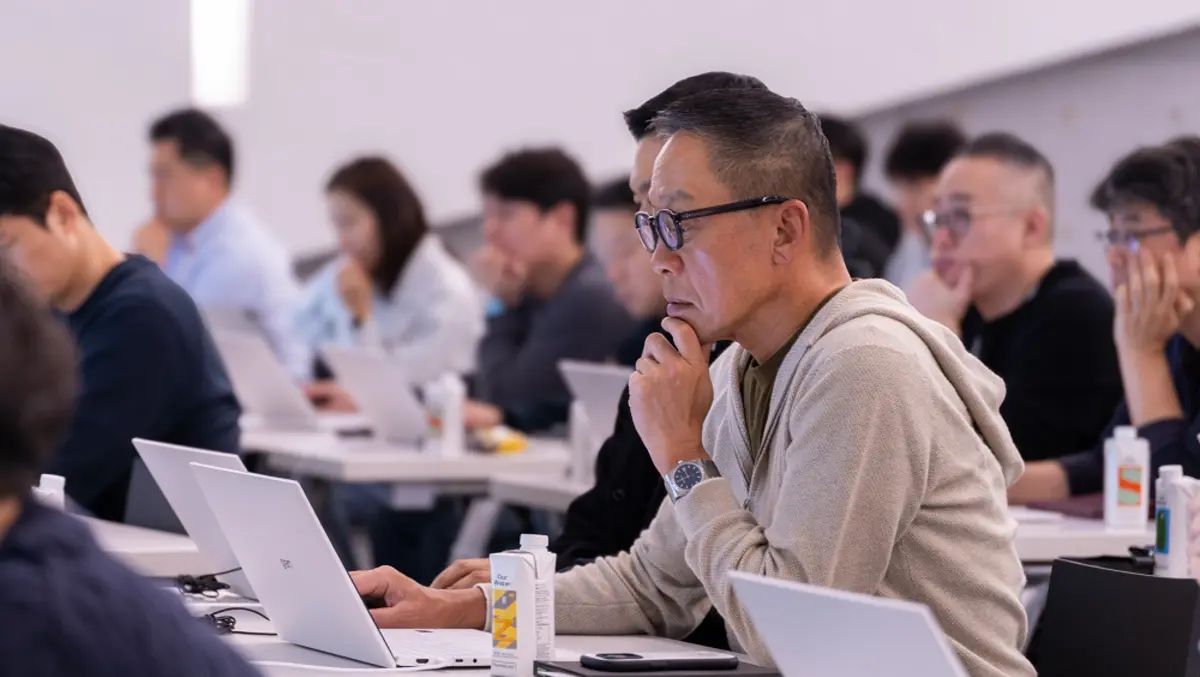
Vice Chairman and Chief Executive Officer Ted Chung took part in the sessions alongside employees. His participation signals that the company wants senior management to understand the tools directly rather than treat AI as a specialist subject handled only by technical teams.
"Leaders probably won't be doing vibe coding themselves in their day-to-day work, but executives must grasp the fundamentals to speak the same language as working-level teams," Chung said.
"Seeing coding tasks that once took two days completed automatically in under a minute is nothing short of extraordinary," Chung said.
Hyundai Card said its next round of training for senior leaders will focus on operational risks linked to large language models and the governance needed to manage them. That includes understanding the limits and weaknesses of AI systems as well as their uses inside the business.
"While responding swiftly to the rapid pace of AI innovation, we will scale our implementation thoughtfully by weighing the specific operational characteristics and risk profiles of each business function," the representative said.
"Our objective is to continuously cultivate a work paradigm where both AI and human talent play to their distinct strengths," the representative said.