


Hyundai Card sees strong teen uptake for Apple Pay cards
Mon, 6th Jul 2026 (Today)
Nearly 70% of holders of Hyundai Card's Apple Pay Rewards debit and hybrid cards in South Korea were in their teens or 20s within 50 days of launch, highlighting strong early uptake among younger consumers.
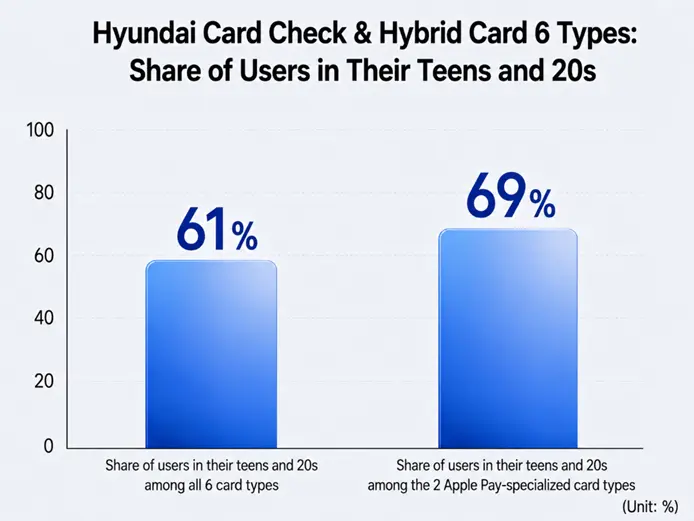
The cards were part of a six-card debit and hybrid line-up introduced in April. Analysis of issuance data showed customers in their teens and 20s accounted for 61% of all sign-ups across the new range, 13% higher than for Hyundai Card's existing debit and hybrid portfolio.
The highest concentration of younger users was in the two products tied directly to Apple Pay rewards: the Hyundai Card Check Card (Apple Pay Rewards) and the Hyundai Card Hybrid Card (Apple Pay Rewards). Together, they drew 69% of issuance from customers in their teens and 20s.
Transaction data suggests regular use rather than one-off sign-ups. Apple Pay transactions accounted for 60% of total payment transactions on the Hyundai Card Check Card (Apple Pay Rewards) and 52% on the Hyundai Card Hybrid Card (Apple Pay Rewards).
That pattern indicates the cards are being used for routine spending by customers already comfortable with mobile payments on iPhone and Apple Watch. In South Korea's competitive payments market, card issuers have been looking for ways to win younger customers early, particularly those who may start with debit-style products before moving on to credit cards.
Product focus
Hyundai Card launched six new debit and hybrid cards in total. Four of them, including point and cashback versions of its debit and hybrid products, offer a 10-times multiplier for points or cashback in categories such as dining, food delivery, convenience stores and public transport.
Outside those categories, the cards provide unlimited M Point accumulation or cashback. The two Apple Pay Rewards cards differ from the rest of the line-up with a simpler structure built around a flat 10% cashback on Apple Pay transactions.
That straightforward approach appears aimed at first-time or relatively inexperienced card users. Younger consumers entering the card market often prefer products with easy-to-understand benefits over reward systems tied to multiple thresholds or category rules.
The distinction between debit and hybrid products also matters. Debit cards draw directly from a linked bank account at the point of sale, while hybrid cards can switch to a credit transaction if the account balance is insufficient. That offers more flexibility for consumers who may not yet want, or qualify for, a standard credit card.
Existing users
The launch also attracted current Hyundai Card customers. Some 31% of applicants for the six new debit and hybrid cards were already Hyundai Card members.
Among those existing members, nearly half chose the Apple Pay Rewards versions. That points to demand not only from new users, but also from customers who already used Hyundai Card and wanted products tied more closely to Apple Pay.
Hyundai Card has held a notable position in the domestic market since becoming the first card issuer to introduce Apple Pay in South Korea. The latest figures suggest it is using that foothold to broaden its reach among younger consumers by linking mobile wallet use with entry-level card products.
This matters because customer acquisition in financial services often depends on securing regular use in everyday spending categories. If a card becomes the default option for transport, food, convenience stores and small retail purchases, the issuer has a stronger chance of retaining that customer as financial needs expand.
Hyundai Card framed the early response as part of a broader effort to build relationships with consumers at the start of their payment card use. For card issuers, younger account holders can represent a long-term source of future lending, cross-selling and loyalty if they remain engaged as income and spending rise.
South Korea's card market is crowded, and rising mobile payment adoption has increased pressure on issuers to differentiate products beyond traditional points schemes. By combining simple cashback with Apple Pay and debit-style access, Hyundai Card appears to be targeting a segment that values convenience and clarity over more complex reward models.
A Hyundai Card official said: "The new debit and hybrid cards have received a strong response from customers in their teens and twenties from the initial launch phase. As Hyundai Card continues to expand touchpoints with customers who are just beginning to use payment cards, these products are expected to play a meaningful role in broadening the company's future customer base."