

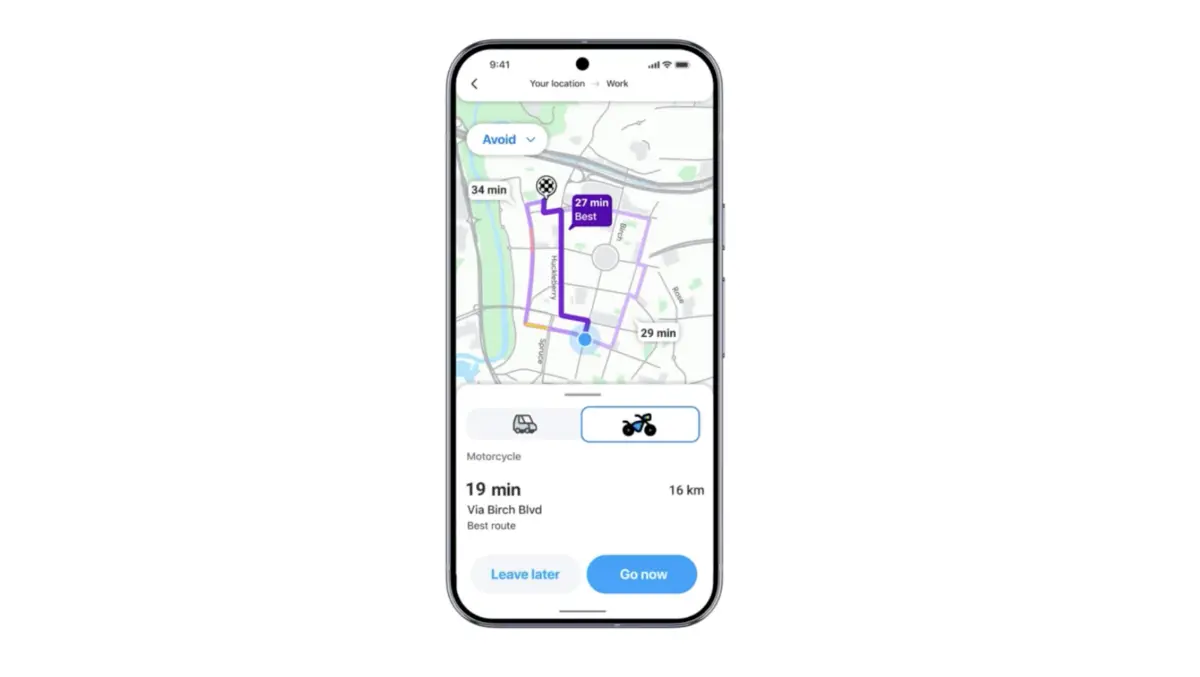

Waze has introduced new customisation features and expanded Gemini-based functions in its navigation app, including a motorcycle mode in seven countries.
The update also adds personalised route suggestions, a quieter voice guidance setting and broader conversational reporting tools. A new Gemini search feature is launching first to Waze's beta community.
Motorcycle mode
The motorcycle mode is intended for riders whose route needs differ from those of car drivers. It uses artificial intelligence to account for shortcuts and restrictions that affect two-wheelers, with the aim of improving route selection and estimated arrival times.
It also highlights hazards that can be harder for motorcycle riders to navigate, including potholes, speed bumps, raised crosswalks, shoulder endings and narrow bridges.
The feature draws on real-time traffic data and input from a dedicated group of motorcycle map editors who add hazards to the map. It is rolling out on Android and iOS in Argentina, Brazil, Colombia, Malaysia, Mexico, Peru and the Philippines.
Route preferences
Another update gives users route suggestions based on previous journeys. The app combines a driver's past trip choices with local traffic data when ranking route options.
That means users who tend to favour motorways over local streets with multiple stops may see those routes presented first. Drivers can still choose alternative routes or switch off personalisation in the app's settings.
Personalised navigation is rolling out globally on Android and iOS.
Fewer prompts
Waze is also adding what it calls a "less chatty" mode for users who want fewer spoken interruptions while listening to music or podcasts. In this setting, the app reduces the number of voice prompts and shortens them, while continuing to issue alerts for hazards, turns and lane changes.
Those reminders will be delivered less often than in the standard mode. The feature is rolling out globally on both major mobile platforms.
Gemini features
Several updates expand Waze's use of Gemini in reporting and search. Conversational Reporting already lets users report traffic incidents in natural language, and Waze is now extending that approach to map changes such as road closures and outdated addresses.
Users can speak directly to the app to flag an issue, and the details are then sent to local map editors for verification before any change is made to the map. That update is also rolling out globally on Android and iOS.
Waze is also introducing a voice-led destination search feature built with Gemini for its beta community. The tool is designed for users who know the type of place they want but do not have a precise destination in mind.
Users can make requests such as a coffee shop that is open, parking near a specified location or a nearby petrol station with the lowest prices. Waze then returns a list of options that can be selected by voice for navigation.
The latest release points to a broader effort by Waze to let drivers decide how much guidance they receive and how they interact with the app. It also reflects how Google-owned mapping and navigation products are incorporating conversational artificial intelligence into routine driving tasks such as reporting incidents, updating maps and choosing destinations.
In outlining the changes, Gai Berkovich, vice president and general manager of Waze, said: "Whether you're riding a motorcycle or want fewer voice prompts when you're listening to music, Waze's latest features - including new Gemini updates - give drivers more flexibility on the road."
He added: "Because no two trips are alike, we're adding new ways to customize your ride so you have even more control over your journey."